Read · 40% of the score Read · 40% of the score
31.8%
of the whole web passes this
An agent can work out how the page is organised from its HTML.
The score · September 2026
The AWCS score is a percentage that says how ready a website is for the AI agents that read it. Lighthouse does the measuring, we decide how the measurements add up, and this page explains exactly how. In September 2026 the whole web averages 34.3%.
More and more of the visits to your site are AI assistants that have to read the page, work out what is on it and sometimes do something there, such as find a price or fill in a form. A site built only for human eyes can be invisible to them, and the AWCS score puts a number on that every month, for the whole web.
Lighthouse, Google's tool for auditing web pages, has a category of audits written for AI agents: Agentic Browsing. Our score is built from those audits and from the site's robots.txt, which HTTP Archive collects in the same crawl, and it is the same Lighthouse that HTTP Archive runs on every page of the census.
| Dimension | Lighthouse audit | What it checks |
|---|---|---|
| Read | agent-accessibility-tree | Agents can parse the page structure |
| Stable | cumulative-layout-shift | The share of pages that do not move while they load, meaning Lighthouse rates their layout shift as good |
| Guide | llms-txt | A valid llms.txt tells agents what matters |
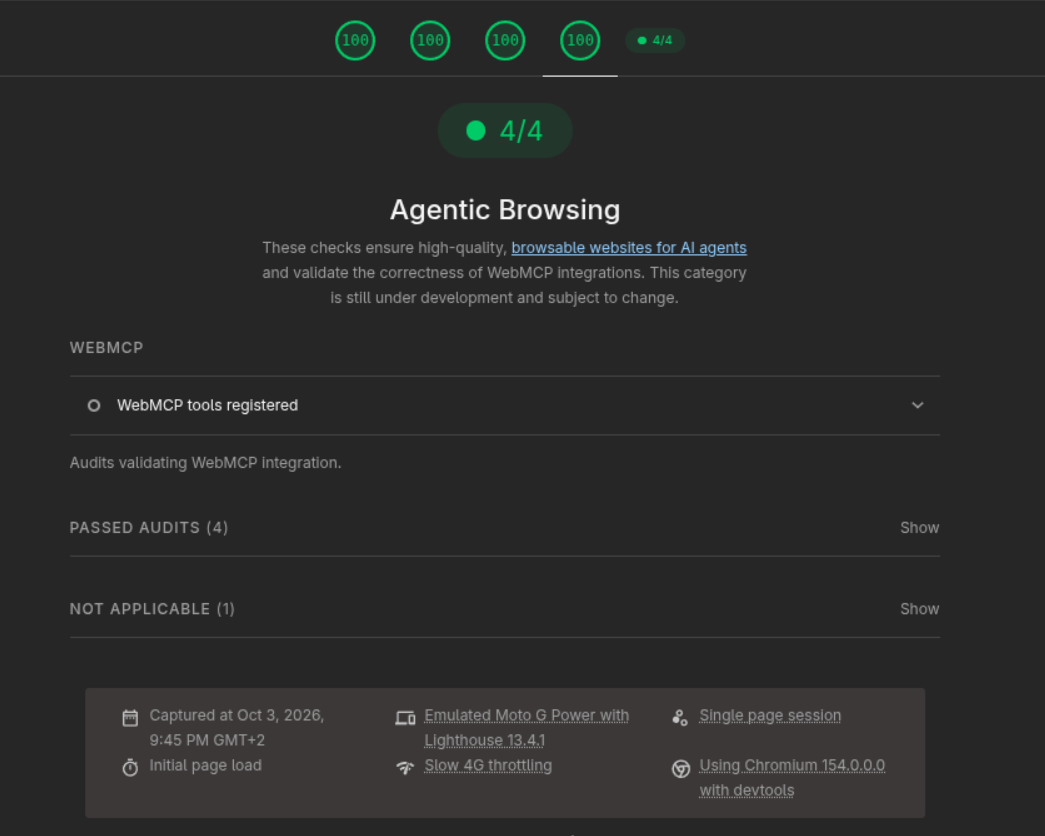
| Act | webmcp-registered-tools | Sites exposing WebMCP tools an agent can call |
| Reachable | None: it comes from the site's robots.txt, as HTTP Archive collects it | What share of the AI agents we track can reach the site |
All of them add to the score by their weight except the one that multiplies whatever the others add up to, which is why a site can do everything right and still score zero. The percentage on each card is the share of the whole web that passes that dimension this month.
Read · 40% of the score Read · 40% of the score
31.8%
of the whole web passes this
An agent can work out how the page is organised from its HTML.
Stable · 25% of the score Stable · 25% of the score
78.2%
of the whole web passes this
Your page holds still while it loads.
Guide · 20% of the score Guide · 20% of the score
14.2%
of the whole web passes this
You serve an llms.txt at your root, and it parses.
Act · 15% of the score Act · 15% of the score
4.6%
of the whole web passes this
Your site exposes WebMCP tools an agent can actually call.
Reachable · multiplies the rest Reachable · multiplies the rest
95.8%
of the whole web passes this
Your robots.txt does not turn away the AI agents you want reaching you.
Read is worth 40% of the score, Stable 25%, Guide 20% and Act 15%. Read comes first because an agent that cannot read the page gets no further, and a page that moves while it loads makes it click the wrong thing. Reachable multiplies the total. Pass it and your total stands; fail it completely and your total becomes zero, however good the others were, because an agent the robots.txt turns away never fetches the page at all. The table shows the same site in different scenarios:
| Scenario | AWCS |
|---|---|
| An agent can read it, and that is all | |
| It can be read and it has a valid llms.txt | |
| It can be read and it does not move while it loads | |
| All of them, and every agent is let in | |
| All of them, but the robots.txt blocks every agent by name |
This scale is not the one your instincts are set to, because almost no site gets near the top of it. So every figure on this site carries a word, taken from this table. We decide where the boundaries between words sit, and they do not come from a measurement: if we move one, a figure keeps its value and changes its name.
| Word | Range |
|---|---|
| Very poor | 0 – 10% |
| Poor | 10 – 25% |
| Weak | 25 – 40% |
| Fair | 40 – 60% |
| Good | 60 – 80% |
| Excellent | 80 – 100% |
From HTTP Archive, which crawls millions of sites every month with Lighthouse and publishes the results for anyone to read. We read a representative sample of it (with Lighthouse 13.4.0 this month), compute the score and publish it. Every figure on this site carries the sample it came from and its margin of error, and a movement smaller than its margin is published as a tie rather than as a change.